Why retro UI is having a moment
After a decade of flat design and hyper-minimalism, interfaces started to feel interchangeable. Every product looked like the same gray rectangle with a thin sans-serif font. So it is no surprise that designers are reaching backward for warmth, personality, and a sense of place. Retro-futurism is now one of the most popular graphic design directions heading into 2026, and a retro UI kit is one of the clearest ways to bring that energy into a real product.
Part of the pull is emotional. As technology started to feel intrusive rather than liberating, people gravitated toward aesthetics that feel warmer and more tangible. Chunky buttons, visible seams, and screens that look like they belong to a physical machine all push back against the frictionless, invisible interfaces that dominate today. There is comfort in an interface that looks like it has weight.
There is also a generational twist. Gen Z did not grow up with floppy disks and dial-up modems — they discovered them. For that audience, retro design is nostalgic in a curious, playful, refreshingly unpolished way rather than a sentimental one. That distance is exactly what makes the aesthetic feel fresh again. When we built our own kit, we did not invent a look from scratch; we assembled it from a handful of older movements. These are the inspiration sources behind it.
Cassette futurism: the warmth of chunky hardware
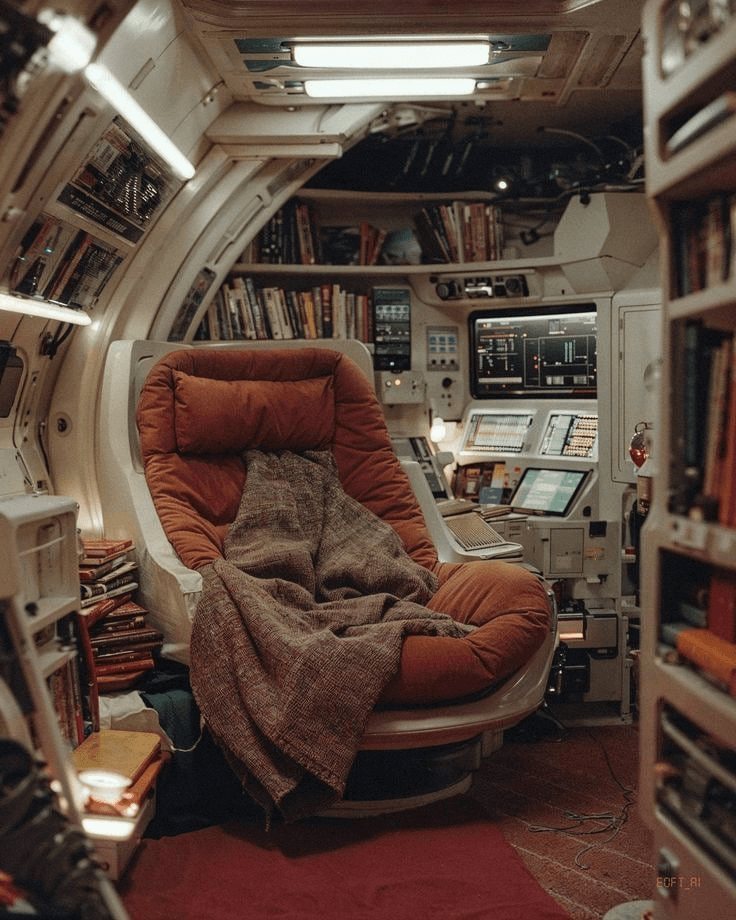
Cassette futurism is the single biggest influence on our retro UI work. It describes a retrofuturistic technological aesthetic drawn from roughly 1970 to the mid-1990s — early microcomputers, late-Cold-War instrumentation, and the imagined future as it appeared in films like Alien and Blade Runner. It is the look of a future built before the smartphone flattened everything into glass.
What makes it compelling for interface design is its physicality. This aesthetic relies on chunky, tactile buttons, segmented readouts, amber and green monochrome displays, and simple panels that prioritize legibility over decoration. Nothing is hidden behind a hamburger menu; every control announces itself. Recent productions like Alien: Romulus, Silo, and Severance have driven a noticeable resurgence of this exact style, proving that audiences still find these heavy, mechanical interfaces deeply satisfying.
In our kit, cassette futurism shows up as the foundation of what we think of as retro gadget design — components that look like they were milled, not rendered. Bordered panels, status lights, and monospace labels give each screen the feel of a dedicated device rather than another tab in a browser. It is the connective tissue that holds the rest of the influences together.
Retrofuturism and the future we were promised
Where cassette futurism is grounded in real hardware, broader retrofuturism is about optimism. It imagines the future through a vintage-tinted lens: the gleaming space-age tomorrow that mid-century design promised but never quite delivered. That tension between past and future is exactly what gives a retro UI kit its emotional charge.
For a digital product, retrofuturism is less about literal chrome and rockets and more about attitude. It reintroduces personality, emotion, and playful storytelling into experiences that minimalism had stripped bare. A loading screen can feel like booting a vintage terminal. A success state can echo the satisfying clunk of analog machinery. These small narrative moments are what users remember.
We borrow this spirit when we want an interface to feel hopeful and a little theatrical. Saturated palettes, bold geometric framing, and confident typography signal that the product has a point of view. Retrofuturism reminds us that an interface does not have to be neutral to be usable — it can have a worldview.
Cyberpunk UI: neon, density, and information
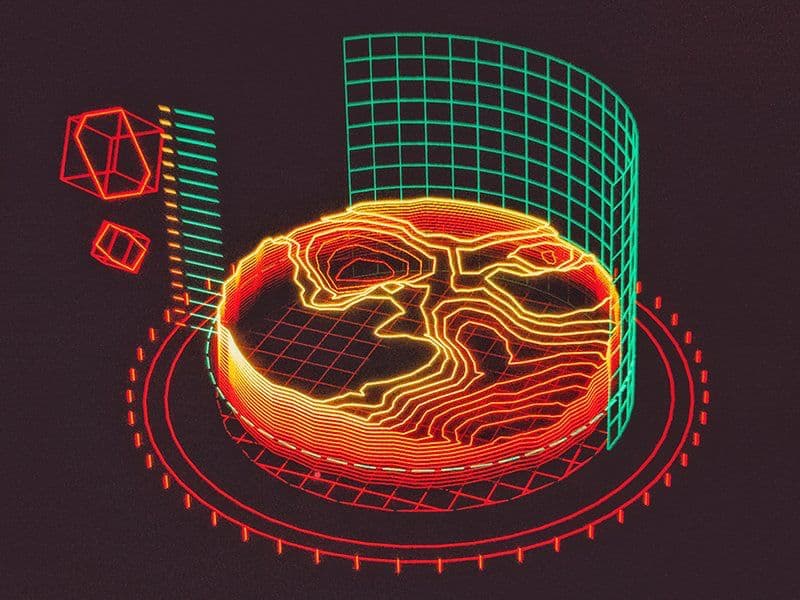
If retrofuturism is the bright promise, cyberpunk is the rain-soaked flipside. A cyberpunk UI leans into density, high contrast, neon accents against near-black backgrounds, and the feeling that you are reading a system that knows more than it lets on. Think of the layered, glowing displays of a neon-noir city rather than a calm dashboard.
The appeal of cyberpunk UI is information richness. Where minimalism hides complexity, cyberpunk embraces it — multiple panels, live readouts, monospaced data, and accent colors that guide the eye through a busy screen. Done carelessly this becomes noise, but done well it makes a power-user tool feel immersive and capable. Glitch effects, scanlines, and high-saturation gradients all trace back to this lineage.
In our kit, the cyberpunk influence lives in the dark theme and the accent system. It is the mode you reach for when a product needs to feel technical, fast, and slightly dangerous, without abandoning the legibility that cassette futurism insists on.
Arcade UI and pixel art
No retro interface vocabulary is complete without the arcade. Arcade UI brings high-score energy: bold, blocky type, primary colors, and the unapologetic confidence of a machine built to grab your attention from across a room. It is loud by design, and that loudness is a feature.
Closely tied to this is pixel art, which remains one of the most beloved retro visual styles on the web. Pixel art carries an enormous amount of character in very few pixels, and that constraint is precisely its charm. A small pixel art icon or mascot can give a product more personality than an entire library of polished vector illustrations. The deliberate roughness reads as honest rather than dated.
We use arcade UI and pixel art sparingly but deliberately — for badges, empty states, achievement moments, and the occasional mascot. They inject play into an interface and reward users for paying attention. A pixel art flourish at the right moment turns a routine confirmation into a small celebration.
Retro web design and the charm of the old web
The final ingredient is retro web design itself — the unpolished aesthetic of the early internet before everything converged on the same template. Visible borders, tiled backgrounds, distinct sections, and a general sense that a human hand made each page. The early web was clumsy, but it had character, and that character is exactly what the trend is recovering.
This influence pairs naturally with the ongoing tension between the Y2K aesthetic and neo-brutalism, two of the most talked-about directions in web design right now. Both reject the safe, rounded sameness of modern templates: one through saturated, nostalgic optimism and the other through raw, structural honesty. A good retro UI kit lets you lean in either direction without rebuilding from scratch.
When we apply retro web design, the goal is not to make a product look broken or old. It is to recover the warmth and individuality the old web had before best practices sanded everything smooth. Borrowing its honesty — clear structure, visible edges, real personality — is what ties cassette futurism, cyberpunk, arcade, and pixel art into one coherent system rather than a costume.
Putting the influences together
None of these aesthetics works in isolation. Cassette futurism gives the kit its tactile foundation, retrofuturism supplies optimism, cyberpunk UI adds density and drama, arcade UI and pixel art bring play, and retro web design supplies the honest, hand-made structure that holds it all together. The craft is in the balance — pulling enough from each to feel intentional, without tipping into pastiche.
That is the real lesson behind any retro UI kit and any approach to retro gadget design: nostalgia is a starting point, not the destination. The aesthetics that inspired ours are decades old, but the goal is thoroughly modern — interfaces that feel warm, distinctive, and genuinely human in a sea of identical gray rectangles.
If you want to build with these influences instead of recreating them from scratch, you can get the Retro Futuristic UI Kit on Gumroad.