What is Intervio and why does it exist
Traditional user interviews are one of the most valuable tools in a product team's arsenal, but they come with a brutal bottleneck: time. A single 30-minute interview can take two to three hours when you factor in scheduling, conducting, transcribing, and analyzing. Multiply that across dozens of participants and you're looking at weeks of work before a single insight reaches a decision-maker. According to recent research, 95% of researchers now use AI tools regularly in their workflow as of 2026, up from 67% just a year earlier. The demand for faster, scalable qualitative research has never been higher.
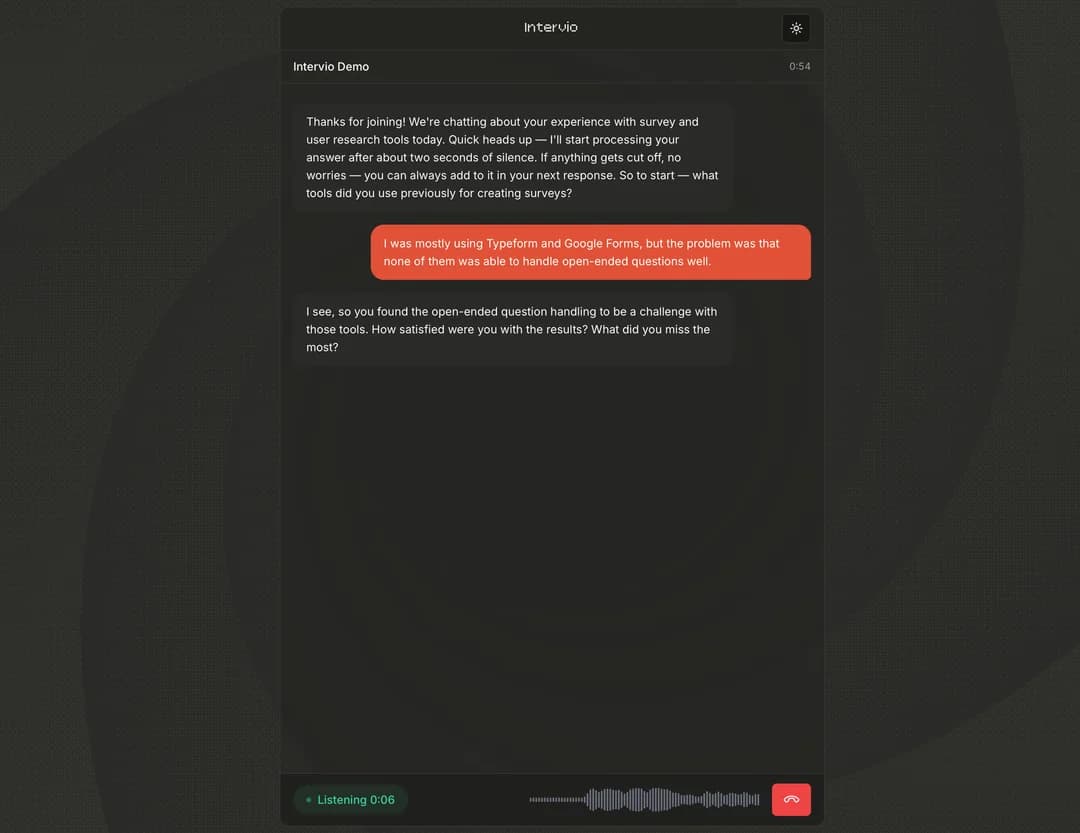
Intervio was built to solve exactly this problem. It's an AI-powered voice interview platform that conducts natural, adaptive conversations with participants, transcribes everything in real time, and synthesizes findings across all sessions automatically. Participants join from any browser with a single link — no app downloads, no scheduling back-and-forth. The AI interviewer listens, asks follow-up questions, and probes deeper based on what respondents actually say, much like a skilled human researcher would.
This isn't about replacing human judgment in research. It's about removing the mechanical overhead so researchers can focus on what matters: interpreting data, identifying patterns, and making better product decisions. Intervio handles the repetitive work while keeping the depth and nuance that makes qualitative research valuable in the first place.
How the AI interviewer actually works
The core of Intervio is its adaptive AI interviewer. Unlike rigid survey tools that follow a fixed script, Intervio's AI listens to each response and dynamically generates follow-up questions based on what the participant actually says. If someone mentions a pain point, the AI probes deeper. If an answer is vague, it asks for specifics. This creates conversations that feel natural rather than robotic.
Smart silence detection is another key feature. Instead of using rigid timers that cut people off mid-thought, the system processes responses after natural pauses in speech. This means participants can take their time thinking without feeling rushed, which leads to more thoughtful and honest answers. Research on AI-conducted interviews has shown comparable information entropy to human-led interviews, with high semantic coherence and positive user experience feedback.
The browser-based approach removes one of the biggest friction points in traditional research: logistics. There's no app to install, no account to create. Researchers generate a link, share it with participants, and interviews happen on their own schedule. This is particularly powerful for reaching participants across different time zones or those who might not show up for a scheduled video call.
Automatic transcription and per-session analysis
Every Intervio conversation is transcribed in real time and analyzed the moment it ends. Each session gets an automatic summary highlighting the key themes discussed, sentiment detection tagging responses as positive, negative, or mixed, and key quote extraction that surfaces the most important moments without requiring anyone to listen through the entire recording.
This per-session analysis alone saves hours of work. In traditional research workflows, transcription is often the most tedious step — and it's usually where projects stall. A 2026 report on interview transcription trends found that AI-powered transcription has become the standard across professional research, with accuracy rates exceeding 95% for clear audio. Intervio builds this directly into the interview flow rather than treating it as a separate step.
The searchable, exportable transcripts mean that nothing gets lost. Researchers can search across all sessions for specific terms, filter by sentiment, or pull key quotes for stakeholder presentations. Every data point is traceable back to its source session, maintaining the rigor that qualitative research demands.
Cross-session synthesis: seeing the bigger picture
Where Intervio really differentiates itself is in cross-session synthesis. Instead of reading through transcripts one by one and manually coding themes in a spreadsheet, the platform automatically identifies patterns and themes across all your interviews. After running 10 or 20 sessions, you get a synthesized view showing which topics came up most frequently, what the common pain points are, and where participant opinions converge or diverge.
The synthesis engine generates actionable recommendations backed by evidence. Every insight is linked to specific quotes and sessions, so you can always trace a finding back to its source. This is critical for maintaining credibility when presenting research findings to stakeholders — you're not just sharing opinions, you're sharing data-backed conclusions with direct participant quotes as evidence.
For product teams running continuous discovery, this capability changes the game. Instead of batching research into quarterly studies that take weeks to analyze, teams can run ongoing interviews and get synthesized insights as they accumulate. Existing studies demonstrate that large language models can effectively automate thematic analysis while substantially improving efficiency and consistency when handling large qualitative datasets.
Who Intervio is built for
Intervio serves anyone who needs qualitative insights but struggles with the time and logistics of traditional interviews. Product teams use it for continuous user discovery, running interviews alongside their sprint cycles rather than as a separate research phase. Academic researchers use it for studies that require dozens or hundreds of participant interviews, where manual interviewing would be impractical.
UX researchers benefit from the ability to scale their interview programs without proportionally scaling their time investment. A single researcher can set up an interview guide and collect responses from 25 or even 100 participants in the time it would traditionally take to interview five. The AI handles the conversations while the researcher focuses on analysis and strategic thinking.
The pricing reflects this accessibility: the Starter plan at $49 per month includes 25 AI interviews, unlimited projects, full transcription, per-session summaries, and cross-session synthesis. The Growth plan at $99 per month scales to 100 interviews. Both plans include the complete feature set — there's no feature gating behind higher tiers, just volume scaling. You can get started at intervio.app.
The shift toward AI-assisted qualitative research
Intervio arrives at an inflection point for qualitative research. The field has historically resisted automation because depth and nuance are so central to its value. But the current generation of AI tools doesn't sacrifice depth for scale — it maintains conversational quality while removing the mechanical overhead that limits how much research teams can actually do.
The numbers tell the story: AI use across HR and research tasks climbed to 43% in 2026, up from 26% in 2024, marking a clear shift from pilot programs to real workflows. In qualitative research specifically, the researcher's role has evolved from manual coding and transcription to curation, contextual verification, and ethical oversight. AI handles the repetitive work, freeing researchers to spend more time on interpretation and meaning-making.
Intervio fits squarely into this trend. It's not trying to replace researchers — it's trying to make each researcher dramatically more productive. By automating the interview, transcription, and initial analysis phases, it compresses what used to be weeks of work into hours, letting teams make faster, more informed product decisions based on real user conversations rather than assumptions.